
Every Face You See Is a Memory of a Face
A friend is sitting across from you at a small table at a café. You have not seen them for two years. They look mostly the same. You raise your coffee cup. They raise theirs. The light from the side of their face — the way the morning sun is catching their left cheek — travels from their cheek to your retina at the speed of light.
This sounds like nothing. The table is small. The distance is a metre. The time the light takes is three nanoseconds. But the face you are looking at, in the strictest possible sense, is three nanoseconds old. It is a face that already does not exist. By the time you have noticed it, your friend has already become a slightly different person.

This is true of every face. It is true of every star.
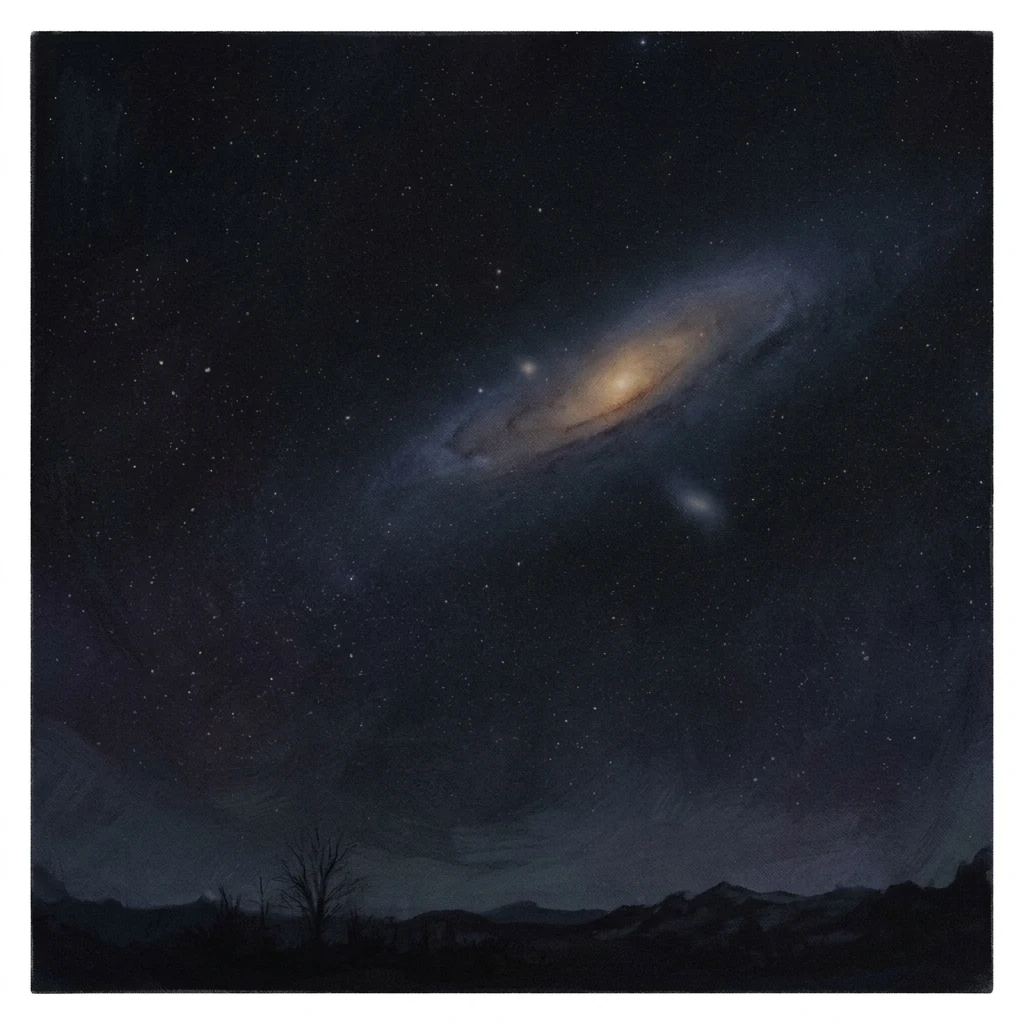
The sun you saw rising this morning is eight minutes and twenty seconds old. The light that left it at that instant was not yet aware that anyone was watching. The nearest star to ours, Proxima Centauri, is four point two years old by the time you see it; if it went out tonight, four Christmases would pass before you noticed. The Andromeda galaxy that you can see, on a dark night, as a small smudge of older-than-everything light, is two and a half million years old by the time you see it. The galaxy that left that light has, by now, rotated and grown and lost stars and gained stars and probably has nothing in common with the smudge in the small but specific way that two and a half million years rearranges a thing.
You think you are seeing the sky. You are seeing a series of memories of the sky, each at a different age, all arriving at the same time on the back of your eye.

The face across the table works the same way. The difference is the time scale. A friend three nanoseconds away. A friend three weeks away — last seen on a video call before they went on holiday. A friend three years away — the version of them you have been carrying since the last dinner. A friend ten years away — the person you went to school with, whose photograph is still in your head, who, when you finally see them again at the funeral, is not the photograph at all. You both pretend to recognise each other. You both are, in fact, comparing the person in front of you to a memory that has not been updated since some specific Tuesday in 2014.

The cells in their face have all been replaced since then. Their organs are different. Their thoughts are different. Their politics are different. You know the friend at the funeral the way you know a star that has been out for years — not because you are seeing them now, but because the light that left them at some other moment has finally reached your eye.
This is not a tragedy. It is the situation. The light works the way the light works. The brain works the way the brain works. The brain is just a slower star.

When you greet a friend you have not seen in three years — when they walk through the airport gate and you smile and start across the floor — you are not, in the strict sense, greeting your friend. You are greeting the friend in your head, the one you have been updating from photos and messages and the occasional voice. The friend in front of you is greeting the friend in their head, the one they have been updating. Two memories are shaking hands.
The miracle is that this works. The two of you fall into step. You catch up. The thing in your head and the thing in front of you converge, mostly, over the next forty minutes. Coffee helps. The eyes do the calibrating. By the end of the first cup, you have brought the memory mostly up to date. By the end of the lunch, you have replaced the version in your head with the version at the table — give or take.

And so the morning sun, eight minutes old, slanting across the table, and so the face across from you, three nanoseconds old, also somehow ten years old, and so you, raising the cup a little, are doing the cosmic version of what every star in the sky has been doing all along: showing yourself to someone late, knowing they will see it as if it were now.
The friend smiles. The friend says something. You laugh. The coffee is good.

Both memories agree.

This is enough.