The Peculiar Intimacy of Telling a Stranger Something You Have Never Told a Friend
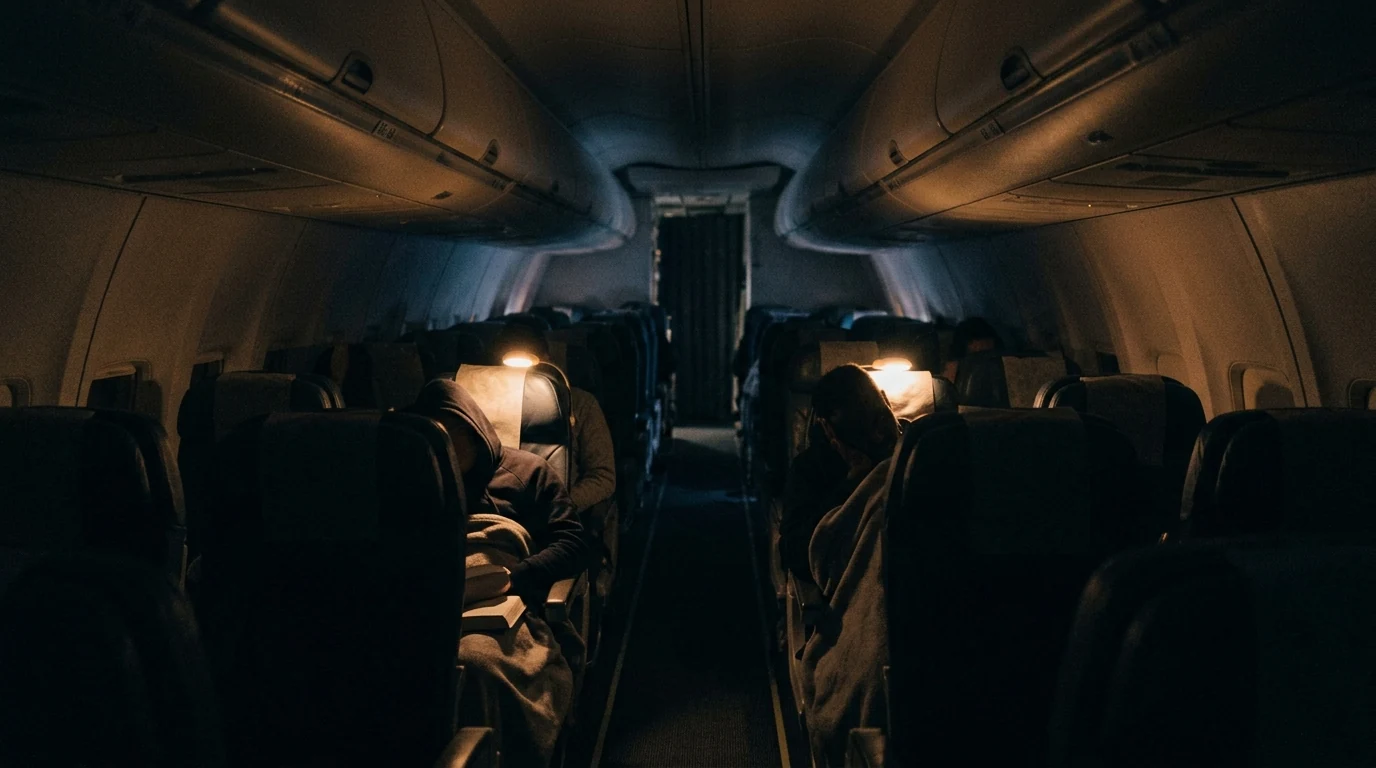
A long-haul flight. Window seat. Middle of the night over an ocean. The cabin is dim and the engines have settled into the long sustained note they make at altitude, the note that sounds, after the first hour, like the sound the inside of your own head would make if you could hear it.
The person next to you — a woman in her forties, headphones around her neck, glasses on the tray table — leans over and asks if you mind if she takes the second little bottle of wine from the netting of your seatback pocket. You say of course. She unscrews the cap with the small precise tilt people learn from years of restaurants, and pours it into a plastic cup, and turns to look at you properly.
She tells you she is flying back from her father's funeral.
You do not know her name. You will not know her name when you part at the gate.
She tells you about her father. Things she has not told her siblings. A small thing he did once, in a kitchen, that was the kindest thing anyone has ever done for her. Another small thing he did once, in a different kitchen, that she has not been able to forgive. A line of his that she still uses, in her own voice now, without telling people where it came from.

You listen.
You are good at listening, partly because you have been doing it for a living, partly because you do not know her name and there is nothing you can do with what she says except hold it. The plane is doing the thing planes do; the engines do their long note; she keeps talking and then stops and looks out at the dark.
Eventually you tell her something. Something you have not told anyone in years. Maybe ever. You are halfway through the sentence before you realise you are saying it. She nods. The plane goes on.

The effect is well-documented enough that there is a name for it.
Sociologists and psychologists call it the stranger on a train phenomenon — sometimes also the express train effect, after a 1975 paper by Zick Rubin describing how people would readily disclose to fellow passengers things they had never told family. The findings have been replicated many times since, on trains, on planes, in late-night queues for taxis, in the corners of bars, in the back rooms of bus stations at three in the morning. Anywhere two strangers find themselves briefly fixed in proximity, with the implicit guarantee that the proximity will end.
A few reasons emerge consistently.
The stranger imposes no future cost. They cannot use what you say to recalibrate a relationship; you do not have a relationship. They cannot bring it up at Christmas. They do not know the version of you who would be embarrassed by this disclosure — the colleagues, the parents, the long marriage; they only know the version of you that exists in the dim seat next to them, in the four hours over an ocean. They have no investment in you, and therefore — paradoxically — no judgemental view of you. The disclosure leaves your hands and goes nowhere it can come back from.
There is also an asymmetry that is rarely named. When somebody who loves you asks what is the worst thing you have ever done?, the question is, in some quiet way, unanswerable. The honest answer would warp the love. The love is built on partly knowing and partly not knowing, and the asking is itself a small request for the love to keep doing what it has been doing. So you give the lighter version. Both of you know what is happening. Both of you let it happen.

When a stranger asks the same question, the question is, briefly, answerable. The asking has no future weight. The answer can be the truth.
And — this is where the essay needs to do its bit of arithmetic — the effect on you is not nothing. The body knows something the language does not. A secret spoken aloud, even to someone who will not remember, is marked by the nervous system as shared. Cortisol falls. Sleep improves. The thought, in the week that follows, comes back with less of the radioactive shimmer it used to have. The mind has accepted the file as having been moved out of its private vault and into a small temporary cache somewhere unreachable, and that is enough. It does not matter that the stranger forgets within a month. The brain has already accepted the move.
The people you love and live with will always be partial vaults. They are vaults because you love them — because some things, said aloud, would force a renegotiation neither of you has the energy to perform. You edit. They edit. The relationship continues, partly because of the editing.
The strangers, briefly, are not vaults. They are the rivers carrying things away.

And so the deepest things you carry sometimes leave you in the company of people whose names you do not know. And so you, at three in the morning over the Atlantic, having just told a woman you will never see again something you have not told the person you sleep next to every night — are doing what humans have always done with the things they could not otherwise put down.
The flight lands. The cabin lights come up. People stand up too soon and bump the overhead bins. The woman puts on her shoes. She turns to you and says — softly, so that no one else hears — thank you. You say, you too.

You do not exchange names. You do not exchange emails. You walk through the same airport. You do not see each other again.
You go home. You hug the person you live with. You do not tell them what you said on the plane. They have enough.
The thing you told the stranger is somewhere now. It is in another person's head, a head you will never look inside. It is also, somehow, no longer entirely in yours.
You sleep.