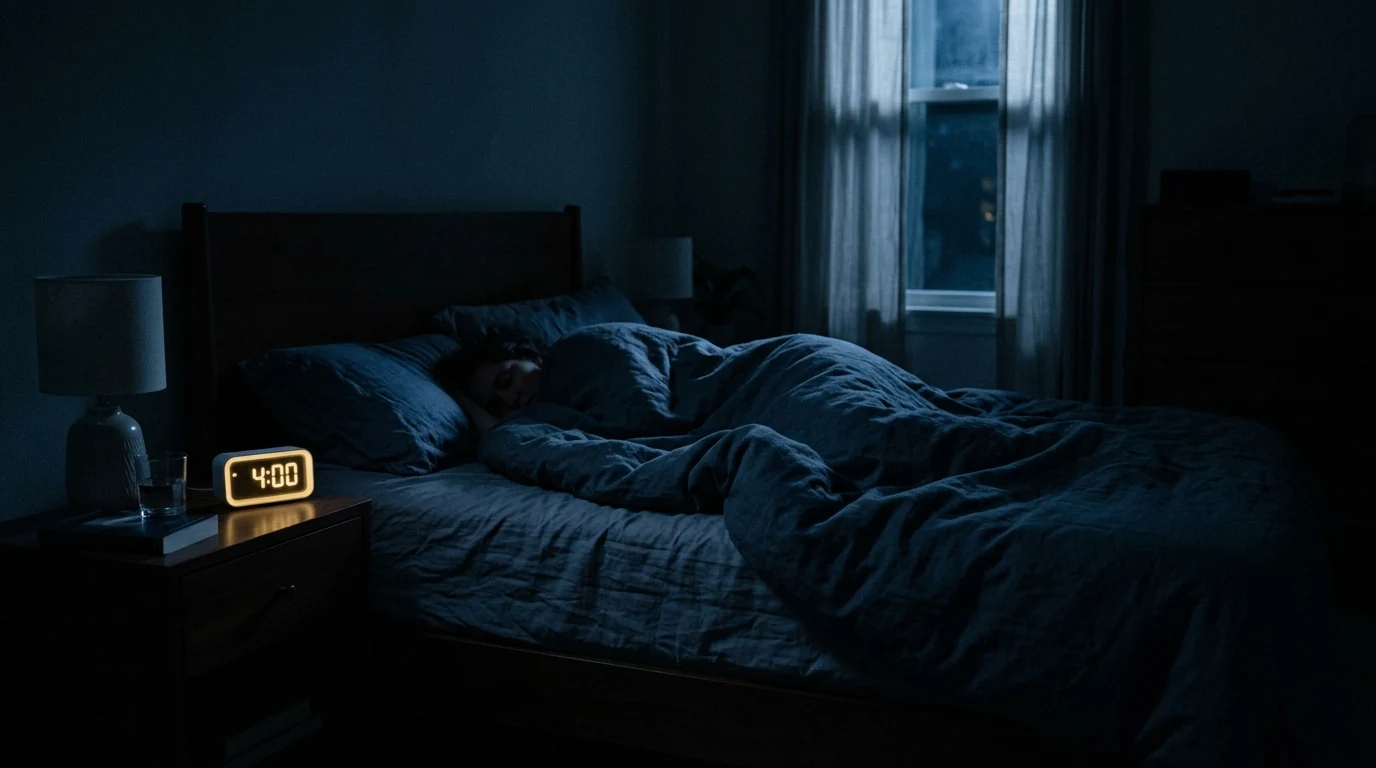
On Being a Stranger in Your Own Head at 4am
Four o'clock. The clock on the bedside is yellow. The room is dark. The body next to you is breathing in the slow way that means deep sleep. You do not know what woke you. You have been awake for what might be three minutes or might be forty.
The brain has done a thing it does at this time of night.
You think: I am alone in this house. You are not alone in this house.
You think: I should not have said that to my brother last Christmas. You said something fine to your brother. Your brother does not remember it. Your brother would, if you asked him, be embarrassed that you remember it.
You think: there is something deeply wrong with me. There is nothing deeply wrong with you, by daylight standards.
The brain has built a small dark room inside the regular dark room and locked you in it. You do not have the key. The day-version of you has the key. The day-version of you is not coming back until about 7:23.
The brain that wakes at 4am is, biologically, a different brain than the brain at 4pm.
Cortisol — the body's main calming-and-regulating hormone — bottoms out somewhere between three and five in the morning. Serotonin and norepinephrine pathways are running at their lowest. The prefrontal cortex — the executive part, the part that says let us not catastrophise, let us look at this honestly, let us wait until morning — is significantly less active in the early hours. The amygdala — the threat-detection module — is, relatively, more active. The chemistry has reorganised itself into a worst-case-scenario engine, and that engine is wired into your normal brain, using your normal memories, while you sleep next to your normal partner in your normal bed.
It does not feel like a different brain.
It feels like you, finally seeing clearly.
That is the dark joke of the 4am hour. The brain is telling you it has just now stripped away the comfortable lies of daytime and is finally showing you the real picture. The brain is wrong about this. The picture it is showing you is not the real picture. It is the worst lens you own, mounted briefly on the camera.
You can verify this with one practical observation. Notes written at 4am, decisions made at 4am, conversations replayed at 4am, almost never look the same at noon. The morning brain reads them and thinks — sometimes — who wrote that? The answer is the stranger who was running the chemistry for ninety minutes. The stranger gets to talk. The stranger does not get to vote.
This is also why the early hours show up so heavily in the worst statistics. Suicide attempts cluster between roughly two and five in the morning. Calls to crisis lines peak in this window. The dark night of the soul is not metaphor; it is the body's circadian dip, played out in a brain that is briefly more amygdala than person. People in the windowless hours do not need new advice. They need to survive the next ninety minutes.
The practical claim follows. Nothing said by the 4am brain should be trusted as truth. The 4am brain is not more honest. It is more chemically depleted. Its conclusions about your marriage, your career, your worth, your past, and your future are produced by a temporarily impaired narrator, and the impaired narrator will be replaced by sunrise.
And so the brain you call your own, at four o'clock on a Wednesday morning, is a stranger — not a metaphor but a different chemistry, a different cortex, a different version of you that will be gone by sunrise. And so you, in the small dark room the stranger has built inside the larger dark room, with the body of someone you love breathing beside you — are being shown a view of your life that is not your view of your life.
You do not get up.
You do not write anything down. You do not check your phone — the phone will weaponise the stranger; the phone has been trained, at great expense, to find the version of you that buys things, and the version at 4am is purchasable.
You close your eyes. You put a hand, palm-down, on the warm body next to you. You do not move the hand. You feel the chest rise and fall under your palm. You wait.

The stranger will leave around 5:30. The morning brain will come back, on its slow chemical schedule, and by 7:23 you will be in the kitchen with the kettle on, looking at the same situations from the night before and finding them manageable. The stranger will not be available for comment.
You will not remember much of what they said. This is, by every available measure, by design.
You sleep again, or you do not. Either way, the room gets lighter. Either way, you survive the next ninety minutes.
That is the only job at 4am. To survive the next ninety minutes.